COMING SOON
COMING SOON
COMING SOON
COMING SOON

RELICS

Monolith III, 1998, rusted steel, 68 x 26 x 35 inches
When I began welding, I was drawn to steel because it felt permanent. I liked the idea that I could make something everlasting that would outlive me. Over time, that thinking changed. I became more interested in what materials actually do, how steel weathers, rusts, and continues to change. These sculptures have their own mortality. In that way, they feel more human. They carry organic processes like oxidation and corrosion that will eventually break them down. Once I embraced their natural physical attributes, the work felt more honest and relatable. The surfaces became a record of time rather than something to control.
The forms in Relics are drawn from familiar objects like arcade games, TVs, toys, trophies, and beer cans, but their translation into steel makes them heavy, generalized, and nonfunctional. Instead of preserving them, I brought them outside and exposed them to chemicals, weather, and time to introduce patina and accelerate deterioration. I wanted the material to participate, not just describe something.
The arcade monoliths are built to the scale and proportion of the originals, but there’s nothing to activate; no screen, no controls, no way in. They signal access through form while remaining closed. They connect to a broader experience of technology at the turn of the millennium: early interfaces that promised entry and depth, but here the content is absent. What remains is just the shell.
The monolithic form also references science fiction, specifically Stanley Kubrick’s 2001: A Space Odyssey, where it represents something powerful and unknowable that drives human evolution but can’t be fully understood. These sculptures echo that feeling, mimicking familiar forms while remaining mysterious. At the same time, technology was advancing quickly, and the idea that it could surpass humans was already present in the culture through science fiction, films like The Terminator, and a growing sense that machines might likely become more capable than we are.
The robot in the series reflects that as well. Based on a mid-century toy, it’s oversized, tired, and worn down. For me, it was also a self-portrait. I was thinking about my role as a maker, working, producing, continuing without fully knowing where it would lead. In my practice, I often felt like a robot, obtaining materials, transporting them, cutting sheet metal, toiling over a torch, my face covered in soot.
Sheet metal holds a personal connection. It was central to a manufacturing business tied to my family’s history. The material carries associations of labor, production, and innovation, but also loss, instability, and collapse. By working with it in an art-making capacity, I’m attempting to reshape that narrative and create a new legacy.
Relics is less about preserving objects and more about accepting cycles, between access and denial, immortality and decay, permanence and loss.

Monolith II, 1998, rusted steel, 74 x 26 x 34 inches

Monolith IV, 1998, rusted steel, 74 x 28 x 33 inches


Relics Drawings, 1998

Robot, 1998, rusted steel, 78x34x22 inches

Monolith I, 1998, rusted steel, 74x28x33 inches
Easter Island, Moai Statues, Rapa Nun people, 1400-1650 AD


Robot, 1998, rusted steel, 78 x 34 x 22 inches


Cans (fall), 1997, annealed and rusted steel, 18.5 x 18.5 x 32 inches

Cans (winter), 1997, annealed and rusted steel, 18.5 x 18.5 x 32 inches

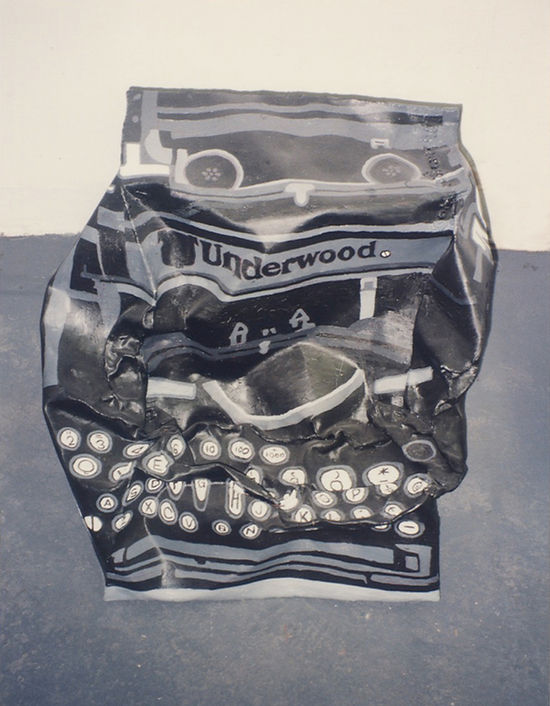
Writer's Block, 1997, painted steel, 18.5 x 18.5 x 32 inches


Cesar Baldaccini, Compession, 1968
Claes Oldenburg, Soft Typewriter, 1963
John Chamberlain, Norma Jean Risen, 1967/1984
Robert Carston Ameson, Smashed Typewriter, 1965


Bud Can, 1998, steel, spray paint, oil stick, 18.5 x 29 x 18.5 inches
Bud Can (winter), 1998, steel, spray paint, oil stick, 18.5 x 29 x 18.5 inches

Smashed, 1997, rusted steel, 13 x 67 x 39 inches

Monument, 1998, rusted steel, 72 x 37.5 x 24 inches

Safe, 1998, rusted steel, 32 x32 x 32 inches